


You've done the hard part. You finally broke the vicious cycle, established a healthy routine, and started seeing real, tangible progress in your daily life. But then, a highly stressful day hits. You are exhausted, overwhelmed by deadlines, and before you even realize what is happening, you are right back where you started—scrolling aimlessly, skipping the gym, or staying up until 3:00 AM.
If you are desperately wondering how to stop falling back into old habits, you are dealing with one of the most frustrating, universal aspects of human psychology. It often feels like a massive failure of willpower or a personal character flaw, but the reality is much more complex and deeply rooted in your biology.
Your brain is evolutionarily wired to seek the path of least resistance. When you are stressed, fatigued, or cognitively depleted, your mind defaults to the deep neurological grooves of your old, familiar behaviors. Overcoming this biological default requires more than just good intentions or a surge of New Year's motivation; it requires a bulletproof, scientifically backed system.
Here is a comprehensive, step-by-step guide to understanding the psychology of habit relapse, practically maintaining your new routines, and ensuring you lock in your progress for good.
The Psychology of Relapse: Why We Revert to Old Patterns
Before you can actively prevent a relapse, you need to understand exactly why your brain actively attempts to sabotage you. Maintaining new habits requires recognizing the hidden psychological triggers that push you off track. If you don't understand the mechanics of your own brain, you will forever be at its mercy.
1. The "Extinction Burst"
When you stop feeding a bad habit, your brain doesn't just quietly accept the change. It throws a neurological temper tantrum known in behavioral psychology as an extinction burst.
I learned this the hard way during my years working as a freelance video editor on platforms like Upwork. After promising myself I'd finally stop working past midnight to protect my health, a single urgent client revision would trigger an intense stress response. Instead of just doing the quick fix and logging off, my brain would amplify the urge to overwork, and I'd fall right back into the grueling habit of rendering massive timelines until the sun came up.
An extinction burst is a temporary, intense spike in the craving right before the habit finally begins to fade. Your brain realizes it isn't getting its usual dopamine hit and panics, aggressively pushing you to revert to the old behavior. If you don't know this burst is a normal part of the process, it feels like a total loss of control.
2. The Stress Default (Amygdala Hijack)
According to research from the Center for Neuroscience at the University of Colorado, chronic stress physically impairs the prefrontal cortex—the logical, decision-making center of your brain responsible for long-term planning and discipline.
When you are stressed by looming deadlines, your brain experiences an "amygdala hijack," handing control back to the basal ganglia, the primitive, efficient area where your automatic (and often bad) habits live. You don't fail because you are weak; you fail because your logical brain literally goes offline to conserve energy.
I frequently experience this when building complex full-stack web applications. When I am staring at a screen, trying to connect a dense Django backend to a Next.js frontend using intricate TSX components, the cognitive load is immense. The moment I hit a frustrating bug, my prefrontal cortex shuts down, and my basal ganglia immediately suggests my oldest stress-relief habit: mindless doomscrolling.
3. The "What the Hell" Effect
In behavioral psychology, this phenomenon is formally known as counter-regulatory eating (though it perfectly applies to all habits). You slip up once—maybe you skip a single workout or eat a donut—and instead of course-correcting, your brain says, "What the hell, I've already ruined the day. I might as well go all out."
I experienced this profoundly when I first began learning technical day trading. I would have a highly disciplined trading plan mapped out using MACD, ATR, and Fibonacci retracements. But if I broke my rule just once by entering a trade prematurely, the "What the Hell" effect would take over. Instead of accepting a small loss, I would abandon my entire system and revenge-trade for the rest of the day, turning a minor slip into a full behavioral relapse driven by all-or-nothing thinking.
According to research by behavioral psychologist Wendy Troop and published in the International Journal of Eating Disorders, this all-or-nothing thinking is one of the most common triggers for habit relapse. Understanding that one mistake does not equal total failure is critical to maintaining long-term progress.
6 Step-by-Step Strategies to Stop Falling Back Into Old Habits
Willpower is a finite resource that depletes with every decision you make throughout the day. To guarantee sustained progress and learn how to stop falling back into old habits, you need to build external systems that catch you when your willpower inevitably fails.
Strategy 1: Actively Track Your "Shouldn't" List
Most productivity advice focuses entirely on what you should do. We are told to track our water intake, our steps, and our reading goals. But when you are trying to maintain hard-won progress, tracking what you are actively avoiding is just as critical.
One of the most effective ways to do this is by keeping a dedicated "Shouldn't List." This brings your subconscious, automatic urges into your conscious awareness, forcing your brain to acknowledge the boundary.
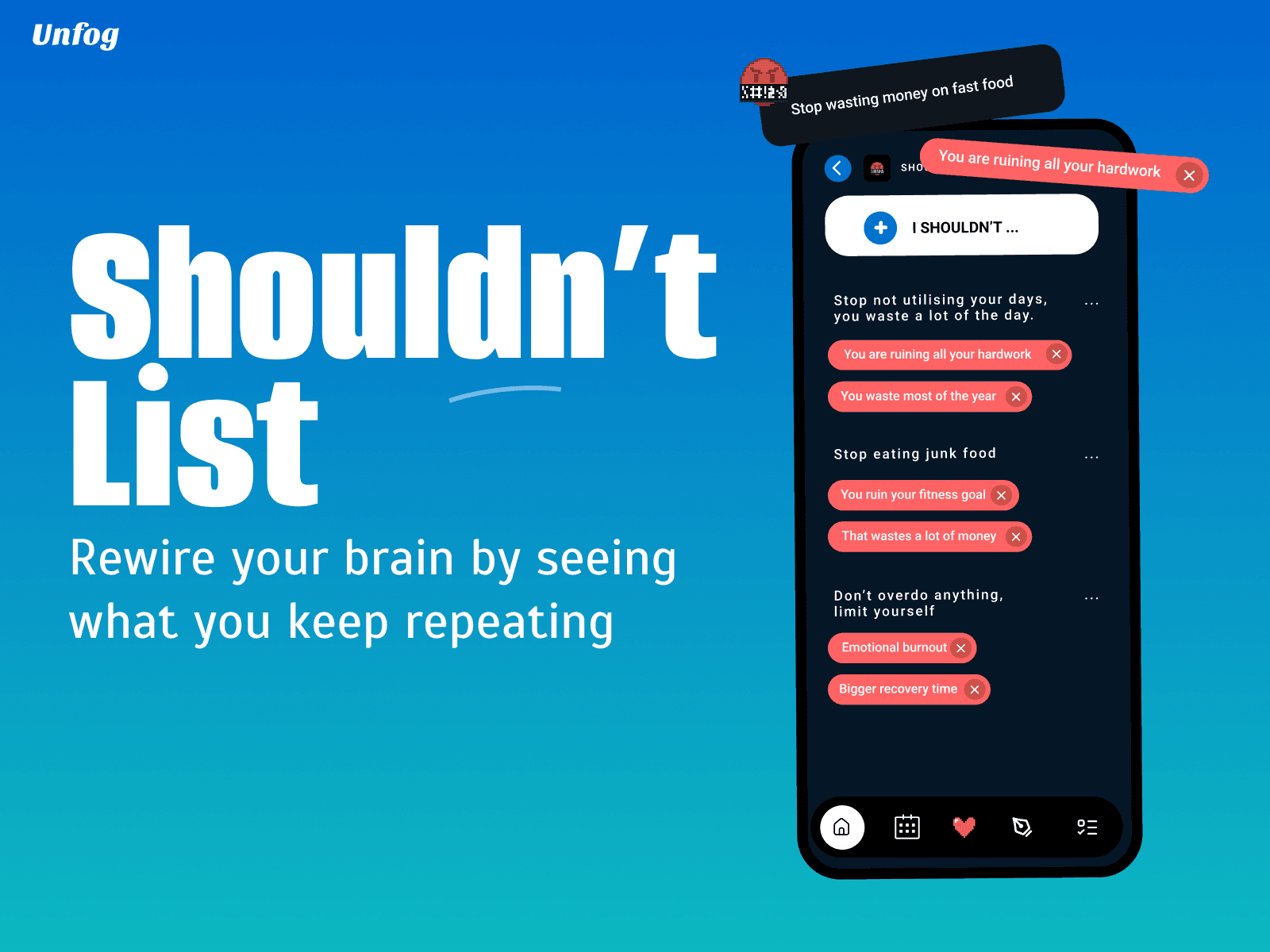
System Tip: Instead of using scattered sticky notes that you will eventually ignore, utilize a holistic habit tracker app like Unfog. While the app is excellent for managing your broader life—allowing you to keep a bucket list for your grandest dreams and manage multiple daily routines—its absolute most powerful feature for relapse prevention is the dedicated "Shouldn't List." When you feel the intense urge to relapse, opening your phone and seeing that specific behavior restricted on your list serves as a powerful psychological speedbump. Learn more about building sustainable habits with Unfog
Strategy 2: Implement "Urge Surfing" with a Physical Journal
When a craving hits, it feels like an emergency. It feels like the urge will last forever unless you give in. However, clinical data from addiction expert Dr. Alan Marlatt shows that neurological cravings usually peak and subside within just 10 to 15 minutes.
Instead of fighting the urge, which only gives it more power, you must learn to "surf" it.
- The 15-Minute Rule: When the craving strikes, do not say "no." Say, "I will wait exactly 15 minutes. If I still want to do it after that, I can."
- Reflect & Externalize: During that window, open a physical notebook (or Unfog's integrated journaling feature if you are on the go). Writing in a physical journal is incredibly grounding. Write down exactly what triggered the urge. Are you anxious? Frustrated by a project? Exhausted? The physical act of writing forces your prefrontal cortex back online, effectively killing the blind impulse.
This technique, known as "urge surfing," was developed by addiction psychologist Dr. Alan Marlatt and has been validated in numerous peer-reviewed studies on behavioral change and relapse prevention.
Strategy 3: Structure Your Vulnerable Hours
Old habits thrive in unstructured time. If you know that 8:00 PM to 10:00 PM is when you usually fall back into unhealthy snacking or internet rabbit holes, you cannot leave that time block empty. Nature abhors a vacuum; if you don't fill that time intentionally, your old habit will seamlessly fill it for you.
Action Step: Build a highly specific "Evening Wind-Down" routine. Instead of just "relaxing," give your brain a specific, enjoyable task. For me, this means picking up my guitar to practice a few acoustic chords or reading a physical book to step away from screens. Having a structured, engaging routine removes the danger of empty time. You can easily switch between your different daily structures using Unfog's routine feature to keep your schedule tightly anchored.
Strategy 4: Replace, Don't Erase (The Habit Loop)
In his seminal book "The Power of Habit," Charles Duhigg explains that you cannot simply delete a bad habit; you have to overwrite it. Every single habit operates on a three-part neurological loop: a cue, a routine, and a reward.
If stress at work is your cue, and your old routine was endlessly scrolling social media to get the reward of mental distraction, you must find a new routine that provides the exact same reward. When you feel stressed, you cannot just sit there and suffer. You must immediately drop and do 20 pushups, or step outside to play soccer for 15 minutes. The new routine (physical activity) still provides the reward (a rush of endorphins and mental distance from the stressor), effectively overwriting the bad habit loop.
This is why trying to simply "stop" a bad habit rarely works—your brain still craves the reward. By replacing the routine while keeping the cue and reward the same, you create a sustainable change that doesn't rely on willpower alone.
Strategy 5: Manage Cognitive Overload
As mentioned earlier, when your brain is overwhelmed by massive, complex projects, it desperately seeks an escape route. To prevent relapse, you must drastically reduce your cognitive load.
Never leave a massive, vague task on your to-do list. "Launch new business" or "Write final essay" are terrifying tasks that trigger procrastination and habit relapse. Break the project down until the steps are ridiculously simple and non-threatening. By utilizing nested subtasks (you can track these seamlessly with Unfog's robust to-do feature), you prevent the task paralysis that usually triggers a retreat into old comforts. Change "Write essay" to "Open Word document and write one sentence."
Research by organizational psychologist Roy Baumeister, author of "Willpower: Rediscovering the Greatest Human Strength," confirms that cognitive depletion is one of the primary drivers of habit relapse. By managing your mental load strategically, you protect your willpower reserves.
Strategy 6: Redesign Your Environment for Friction
Author James Clear popularized the concept of environmental design in his bestselling book "Atomic Habits," noting that your physical environment is the invisible hand guiding your behavior. If you want to know how to stop falling back into old habits, look closely at your workspace, your kitchen, and your bedroom.
Willpower is weak; environmental friction is strong.
- If you are trying to stop checking your phone during deep work, do not just put it face down on your desk. Leave the phone entirely in another room.
- If you want to stop eating junk food, remove it entirely from your kitchen. You are much less likely to eat a cookie if you have to drive 10 minutes to the store to get one. Increase the friction (the number of physical steps) required to do the bad habit, and dramatically decrease the friction required to do the good habit.
Clear's research across thousands of behavior change studies shows that environmental design is 2x more effective than willpower-based approaches for maintaining new habits long-term.
Maintaining New Habits: Playing the Long Game
Maintaining new habits is a completely different skill set than starting them. Starting requires a burst of motivation; maintaining requires profound resilience and self-compassion.
According to a famous study by health psychology researcher Phillippa Lally, published in the European Journal of Social Psychology, it takes an average of 66 days for a new behavior to become automatic. During those two months, you are navigating a minefield of extinction bursts and stress triggers.
To survive the long game, you must fundamentally redefine your relationship with failure. A slip-up is an isolated event. A relapse is a complete return to the old system. If you slip, immediately deploy the "Never Twice" rule: You are allowed to make a mistake once, because you are human, but you must aggressively defend against making the same mistake the very next day.
Stop relying on the myth of perfect discipline. Build a resilient environment, track your restrictions with tools like Unfog, surf your urges with a physical journal, and forgive yourself when you stumble.
Key Takeaways: Your Action Plan for Sustained Progress
To summarize, here are the core strategies for how to stop falling back into old habits:
- Understand extinction bursts and amygdala hijacks as normal parts of the process
- Track your "Shouldn't List" to bring awareness to automatic urges
- Practice urge surfing with the 15-minute rule and journaling
- Structure your vulnerable hours with intentional routines
- Replace bad habits by finding alternative routines that provide the same reward
- Manage cognitive overload by breaking tasks into manageable steps
- Design your environment to increase friction for bad habits and decrease it for good ones
- Apply the "Never Twice" rule when you slip up
- Remember: sustained change takes approximately 66 days of consistent effort
Start Building Your Relapse Prevention System Today
The difference between people who maintain their progress and those who relapse comes down to systems, not willpower. The strategies outlined in this guide are designed to work together as a comprehensive relapse prevention framework.
If you want a tool to tie all these strategies together—tracking your shouldn't list, managing your daily routines, breaking down overwhelming tasks, and maintaining your progress—Unfog is built specifically for people who want sustainable change without the shame-based streaks that traditional habit apps use.
What strategies do you use to avoid falling back into old habits? Share your experiences in the comments below. Your insight could be the breakthrough someone else needs to finally break free from the relapse cycle.
Additional Resources
For deeper dives into habit formation and relapse prevention, check out these resources:
- "Atomic Habits" by James Clear: A comprehensive guide to environmental design and habit stacking
- "The Power of Habit" by Charles Duhigg: Understand the neurological habit loop and how to rewire your behaviors
- Center for Neuroscience Research on Stress and Habit: https://www.colorado.edu/neuroscience (external authority on amygdala hijack and stress response)
- Phillippa Lally's Research on Habit Formation: Published in the European Journal of Social Psychology—the definitive study on how long it takes to form automatic behaviors