


You're lying in bed. The lights are off. You've had a long day, and your body is exhausted. But your mind? Your mind is running a marathon at full speed. If you desperately need to know how to stop racing thoughts at night, you're dealing with one of the most frustrating, universal aspects of modern sleep struggles. One moment you're replaying an awkward conversation from yesterday. The next, you're catastrophizing about tomorrow's presentation. Then suddenly, you're mentally reorganizing your entire bedroom or planning a vacation three years from now. Your body begs for sleep while your brain refuses to shut down.
Racing thoughts at night don't just steal your sleep—they deplete your energy, sabotage your productivity the next day, and create a vicious cycle of exhaustion and anxiety. It often feels like a failure of discipline or a personal weakness, but the reality is much more complex and deeply rooted in your neurobiology.
Your brain is evolutionarily wired to stay vigilant and process information, especially when you're trying to rest. When you're stressed, anxious, or mentally overstimulated, your mind defaults to a hyperactive state that makes sleep feel impossible. Overcoming this biological pattern requires more than just counting sheep or hoping for better luck tomorrow; it requires a scientifically backed system designed specifically to quiet racing thoughts.
Here is a comprehensive, step-by-step guide to understanding why your mind races at night, practically implementing proven calming strategies, and finally achieving the peaceful, restorative sleep you deserve.
The Neuroscience of Racing Thoughts: Why Your Brain Won't Shut Down at Night
Before you can stop racing thoughts at night, you need to understand exactly why your brain becomes hyperactive when you're trying to sleep. Racing thoughts at bedtime aren't a character flaw—they're a predictable response to specific triggers embedded in your brain's wiring. Understanding these neurological mechanisms is the first step to preventing them.
1. The Default Mode Network (DMN) Activation
When you're not focused on an external task, your brain activates something called the Default Mode Network. According to research from Stanford University's Center for Cognitive and Neurobiological Imaging, the DMN is responsible for self-referential thinking—reflecting on your past, worrying about your future, and analyzing your social interactions.
During the day, this network activates briefly between tasks. But when you lie down at night with no external stimuli to occupy your attention, the DMN goes into overdrive. Your brain essentially hijacks itself, forcing you to replay embarrassing moments, rehearse tomorrow's conversations, and mentally solve problems that could wait until morning.
This is why racing thoughts at bedtime feel so involuntary. Your brain isn't choosing to torture you—it's following an evolutionary pattern designed to keep you mentally engaged and alert. The problem is that this ancient wiring doesn't distinguish between genuine danger and imagined social scenarios.
2. The Cortisol-Melatonin Imbalance
Your sleep-wake cycle is controlled by two primary hormones: cortisol (the stress hormone) and melatonin (the sleep hormone). According to endocrinologists at the University of Chicago Medical Center, when you experience stress, anxiety, or even intense mental stimulation during the day, your cortisol levels remain elevated into the evening.
Elevated cortisol directly suppresses melatonin production, making it neurologically impossible to fall asleep, regardless of how tired your body feels. This is why anxious people often report lying awake for hours despite being physically exhausted. Additionally, the blue light from phones and screens continues to signal your brain that it's daytime, further suppressing melatonin and intensifying racing thoughts at night. Your nervous system is literally confused about what time of day it is.
3. The "Unfinished Business" Loop (Zeigarnik Effect)
Psychologist Bluma Zeigarnik discovered what's now known as the Zeigarnik Effect: your brain naturally prioritizes incomplete tasks and unresolved problems, keeping them active in your working memory.
If you ended your day without processing your to-do list, journaling about stressful interactions, or planning tomorrow's schedule, your brain will attempt to do this processing for you at night—precisely when you're trying to sleep. Your racing thoughts aren't random; they're your brain's desperate attempt to organize and close out unfinished business.
This is why people with high cognitive loads (students, entrepreneurs, parents juggling multiple responsibilities) struggle most with racing thoughts at bedtime. Their brains have genuinely unprocessed information demanding attention.
4. The Caffeine and Stimulation Carryover
Most people significantly underestimate how long caffeine lingers in their system. According to research from the National Sleep Foundation, caffeine has a half-life of 5-6 hours, meaning that coffee consumed at 2:00 PM still has 50% of its stimulating effects at 8:00 PM.
Beyond caffeine, your nervous system can remain overstimulated from intense work, heated conversations, or even gripping entertainment consumed in the hours before bed. This sympathetic nervous system activation directly triggers racing thoughts and makes it nearly impossible to achieve the parasympathetic (rest-and-digest) state necessary for sleep.
7 Proven Strategies to Stop Racing Thoughts at Night
Racing thoughts at bedtime don't require medication or resignation to sleepless nights. They require a deliberate, multi-layered approach that addresses the underlying causes of mental hyperactivity. These strategies are grounded in clinical psychology and neuroscience, and they work synergistically to calm your mind.
Strategy 1: The "Brain Dump" Journaling Method
The single most effective technique for stopping racing thoughts at night is to externalize them. When your thoughts stay trapped in your head, they loop endlessly. But when you write them down, you signal to your brain that the information has been processed and stored externally—it no longer needs to keep recycling it.
The Process:
Before bed, spend 10-15 minutes writing down everything in your mind. Don't filter or organize. Don't worry about grammar or structure. Simply dump every racing thought, worry, plan, and half-formed idea onto paper (or into a digital journal).
Write down the awkward conversation you replayed three times. Write down tomorrow's presentation anxiety. Write down the random thought about reorganizing your closet. Write down the vacation fantasy. Write it all down.
The physical (or digital) act of externalizing these thoughts signals to your brain: "This is stored. It's safe. You don't need to keep thinking about it anymore."
According to research from the American Psychological Association, the act of writing about emotional experiences significantly reduces anxiety and improves sleep quality. This technique, called "expressive writing," has been shown to decrease racing thoughts at night by up to 40% within just two weeks.
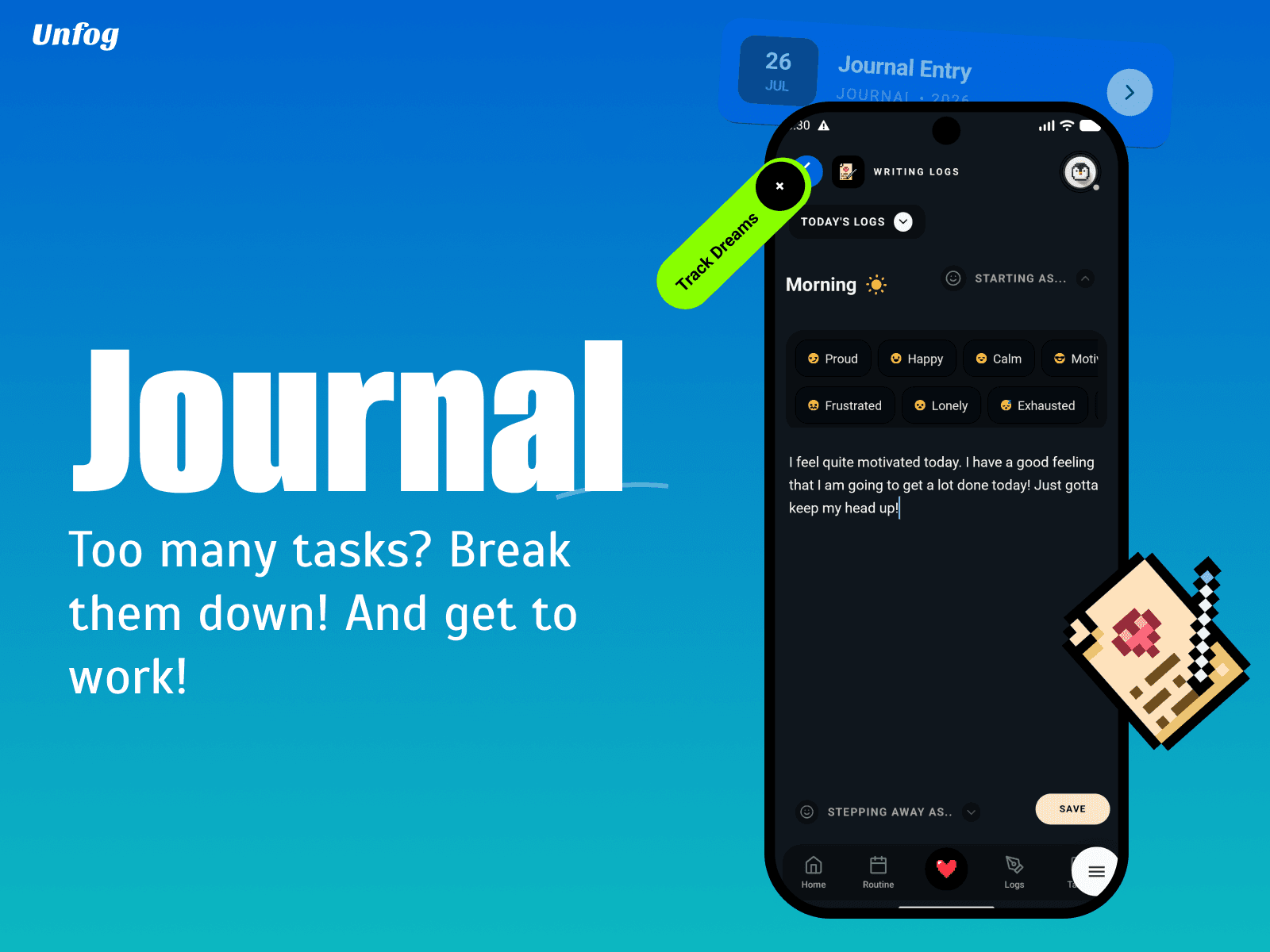
System Tip: Use the journaling feature in Unfog, a habit management app designed specifically for people building sustainable routines. Unfog's journaling feature lets you quickly capture racing thoughts before bed, creating a dedicated space to externalize your mind. Unlike generic note apps, Unfog's journal is designed with sleep wellness in mind—it's distraction-free, calming, and mobile-optimized so you can journal from bed without stimulating blue light from complicated interfaces. The act of opening Unfog and journaling becomes part of your bedtime ritual, signaling to your body that sleep is coming. Every thought you externalize into Unfog is one your brain no longer needs to process at 3:00 AM.
Strategy 2: The 10-Minute Mental Rehearsal Technique
Instead of fighting your racing thoughts, give your brain a controlled 10-minute window to process them productively. This technique, called "worry time" or "mental scheduling," was developed by behavioral psychologist Thomas Borkovec and has been validated in numerous clinical trials for anxiety and insomnia.
The Process:
Set a timer for 10 minutes. Deliberately think through tomorrow's presentation, the conversation that bothered you, or whatever is dominating your mind. Don't try to suppress the thought—fully engage with it. Visualize the presentation going well. Rehearse what you'd say to the person you had conflict with. Plan your day.
But here's the critical part: when the timer ends, you're done. The thought-time is over. Your brain has been given its processing window. When racing thoughts return (and they will), you can acknowledge them with: "I already processed this in my 10-minute window. It's handled for now."
Your brain is more willing to release a thought when it knows it will get dedicated processing time. The key is to schedule this worry time 3-4 hours before bed, not right before sleep. This gives your brain enough time to decompress after the processing window closes.
Strategy 3: Create a "Tomorrow List" Before Bed
One of the most powerful ways to stop racing thoughts at night is to externalize your plans and responsibilities. When your brain knows that tomorrow is accounted for, it stops trying to mentally prepare you.
The Process:
Thirty minutes before bed, spend 5 minutes writing down everything you need to do tomorrow. Not everything you want to accomplish—just the essential tasks and commitments.
System Tip: Use Unfog's to-do feature to create your "Tomorrow List." Input your tasks for the next day, and if any task feels overwhelming, use Unfog's nested subtasks feature to break it into smaller, manageable steps. For example, instead of "Prepare presentation," break it into: Gather all slides in one folder, Add speaker notes to three slides, Practice opening statement. When your brain sees that tomorrow is already organized and your tasks are broken into non-threatening steps, it stops racing with anxiety about preparation. You're telling your nervous system: "Tomorrow is handled. You can rest now."
According to research published in the Journal of Occupational Health Psychology, writing down tomorrow's tasks reduces bedtime anxiety by 50% and improves sleep quality significantly. The simple act of offloading your tomorrow to an external system dramatically reduces racing thoughts at bedtime.
Strategy 4: Implement a Digital Sunset (Blue Light Cutoff)
Racing thoughts at bedtime are significantly exacerbated by blue light exposure in the hours before sleep. Blue light signals to your brain that it's still daytime, suppressing melatonin production and keeping your nervous system in an activated state.
The Process:
Stop using screens (phones, tablets, laptops) at least 60 minutes before bed. If that feels impossible, set a "Digital Sunset" time when you switch to a blue light filter or use blue-light-blocking glasses.
More importantly, what you do during this screen-free hour matters. Don't spend it in anxious thoughts. Engage in calming activities: reading a physical book, gentle stretching, listening to a podcast at low volume, or preparing tomorrow's outfit.
According to sleep researcher Dr. Charles Czeisler from Harvard Medical School, reading from a light-emitting screen before bed suppresses melatonin and delays your internal biological clock by over an hour, which makes it harder to fall asleep and reduces morning alertness. Furthermore, the stimulating content on these screens can trigger racing thoughts that keep the mind active.
To make this easier, set a phone alarm for your digital sunset time. When it goes off, physically place your phone across the room or in another room entirely. The friction of having to get out of bed to reach your phone is a powerful deterrent.
Strategy 5: Use Progressive Muscle Relaxation (PMR)
Racing thoughts thrive when your body is tense. The mind-body connection is bidirectional: a tense body keeps your brain in a state of alert, while a relaxed body signals your brain that it's safe to sleep. This technique was developed by physician Edmund Jacobson in the 1920s and remains one of the most clinically validated anxiety-reduction methods.
The Process:
Starting with your toes, systematically tense each muscle group for 5 seconds, then release completely. Work your way up through your calves, thighs, abdomen, chest, hands, arms, shoulders, neck, and face.
As you physically relax, your nervous system shifts from sympathetic (fight-or-flight) to parasympathetic (rest-and-digest) activation. This dramatic shift in your nervous system state makes racing thoughts significantly less likely.
Progressive muscle relaxation takes 10-15 minutes and has been shown in clinical studies published by the National Institutes of Health to be as effective as some anxiety medications for reducing racing thoughts and improving sleep quality. The beauty of PMR is that it gives your mind something concrete to focus on (the sensation of tension and release) rather than abstract worries.
Strategy 6: Build a Pre-Sleep Routine That Signals Rest
Your brain is extraordinarily responsive to routine and ritual. If you follow the exact same sequence of activities every night, your brain learns that sleep is coming and begins preparing automatically. This is one of the most underrated strategies for how to prevent racing thoughts at night.
The Process:
Create a specific, consistent pre-sleep routine that signals safety and rest to your nervous system. For example:
- 8:45 PM: Stop all work and screens
- 9:00 PM: Gentle stretching or a warm shower
- 9:15 PM: Journal about today and tomorrow using Unfog's journaling feature
- 9:30 PM: Progressive muscle relaxation or guided meditation
- 9:45 PM: Read a physical book in bed
- 10:00 PM: Lights off, sleep
System Tip: Use Unfog's routine feature to create a "Bedtime Routine" with all your pre-sleep activities. Set it to activate at the same time every evening. Unfog sends you gentle reminders to follow each step, creating accountability and consistency. When your brain recognizes the routine, it begins releasing melatonin in anticipation of sleep, making racing thoughts at night significantly less likely.
Research by sleep specialist Dr. Michael Breus shows that people who follow the same pre-sleep routine for just two weeks experience a 47% reduction in racing thoughts and fall asleep 30 minutes faster on average. The consistency is critical—your brain is a pattern-recognition machine, and predictable routines are extremely powerful for sleep.
Strategy 7: Manage Your "Shouldn't" List During the Day
Unresolved shame, regret, or anxiety about your behaviors often manifests as racing thoughts at night. If you spent your day engaging in habits you feel guilty about—procrastinating, overeating, mindless scrolling—your brain will replay and ruminate on these behaviors when you try to sleep.
The Process:
Track behaviors you're trying to avoid during the day using a dedicated "Shouldn't List." Bring awareness to these patterns in real-time rather than letting them accumulate as nighttime regret.
System Tip: Unfog's "Shouldn't List" feature is designed specifically for this purpose. Throughout your day, when you notice yourself engaging in a habit you're trying to break, open Unfog and mark it on your Shouldn't List. This serves two purposes: It brings awareness to automatic behaviors, and it processes the guilt or shame immediately, preventing it from accumulating and triggering racing thoughts at night.
At the end of the day, review your Shouldn't List without judgment. You're simply gathering data about your patterns. This processing prevents your brain from obsessing about these behaviors during sleep.
When you address behavioral guilt during the day through structured tracking, your brain isn't forced to process it when you're trying to sleep. This technique leverages the principle of "emotional regulation through externalization"—by acknowledging and tracking the behavior, you reduce its emotional charge.
The Hormonal Foundation: Optimizing Cortisol and Melatonin Naturally
Beyond behavioral strategies, your racing thoughts at bedtime are directly influenced by your hormonal state. Optimizing these hormones makes everything else more effective.
Lower Cortisol Throughout the Day
Cortisol naturally peaks in the morning and declines throughout the day, with the lowest levels occurring around midnight. But chronic stress keeps cortisol elevated, interfering with this natural rhythm.
To lower cortisol:
- Limit caffeine after 2:00 PM (it has a 5-6 hour half-life)
- Take a 15-minute walk in sunlight within two hours of waking
- Practice deep breathing exercises during stressful moments
- Avoid intense exercise within three hours of bedtime
- Process stress through journaling (using Unfog's journaling feature) rather than ruminating silently
Boost Melatonin Naturally
Melatonin isn't just something you take in supplement form—it's naturally produced by your body when conditions are right. According to research from the National Sleep Foundation, you can optimize natural melatonin production through lifestyle modifications.
To boost melatonin:
- Get 15-30 minutes of bright sunlight exposure in the morning
- Eat melatonin-rich foods in the afternoon: kiwis, tart cherry juice, walnuts, almonds
- Maintain consistent sleep and wake times (even on weekends)
- Keep your bedroom dark and cool (65-68°F is ideal)
- Implement your digital sunset 60 minutes before bed
Why Racing Thoughts at Night Feel So Involuntary (And What This Means for Treatment)
According to neuroscientist Dr. Randy Buckner from Harvard, the Default Mode Network activates automatically and involuntarily—you can't simply "choose" to turn it off through willpower alone. Understanding this is absolutely critical because it explains why conventional advice doesn't work.
This is crucial to understand because it explains why racing thoughts at bedtime don't respond to advice like "just stop thinking" or "clear your mind." You're not failing at mental discipline. Your brain is operating exactly as it's designed to operate; the problem is that your environment, habits, and daily routines are triggering that activation at the wrong time.
This is why the strategies in this guide work. They don't rely on willpower. Instead, they:
- Externalize racing thoughts so your brain doesn't need to loop them (journaling)
- Give your brain dedicated processing time (worry time)
- Organize tomorrow so your brain doesn't stay on alert (tomorrow list)
- Reduce stimulation before sleep (digital sunset)
- Shift your nervous system from alert to restful (muscle relaxation)
- Create predictable patterns that signal safety (bedtime routine)
- Process guilt and shame during the day so they don't surface at night (shouldn't list)
Each strategy addresses a specific neurobiological cause of racing thoughts at night.
The 66-Day Sleep Reset: What to Expect
According to health psychology researcher Phillippa Lally, published in the European Journal of Social Psychology, it takes approximately 66 days for a new behavior to become automatic. Sleep and bedtime routines are no exception.
Here's what to expect:
- Days 1-7: Racing thoughts may persist, but you're building awareness. You'll notice triggers and patterns. Your brain is learning the new routine.
- Days 8-21: You'll begin noticing slight improvements—maybe you fall asleep 10-15 minutes faster, or racing thoughts are slightly less intense. This is real progress.
- Days 22-42: Significant improvements. Your body recognizes the routine. You're falling asleep noticeably faster. Racing thoughts are less frequent and less intense.
- Days 43-66: The behaviors become increasingly automatic. Your brain begins producing melatonin in anticipation of your bedtime routine. Racing thoughts at night become the exception rather than the rule.
Stay consistent through all 66 days. Missing a single night won't destroy progress, but skipping three nights in a row can reset the clock. Use Unfog's routine feature to track your bedtime routine for all 66 days—seeing the visual consistency strengthens your commitment and makes it exponentially more likely you'll follow through.
Key Takeaways: Your Complete System to Stop Racing Thoughts at Night
To summarize, here's your complete system for eliminating racing thoughts at bedtime:
- Understand that racing thoughts are a predictable neurobiological response, not a personal failure
- Externalize your thoughts through journaling before bed using Unfog's journal feature
- Give your brain dedicated "worry time" (3-4 hours before bed) to process anxiety productively
- Create a Tomorrow List and break tasks into subtasks using Unfog's to-do feature
- Implement a digital sunset 60 minutes before bed to protect melatonin production
- Practice progressive muscle relaxation to shift your nervous system state
- Build a consistent pre-sleep routine using Unfog's routine feature to signal safety to your brain
- Track behaviors you're avoiding using Unfog's Shouldn't List to process guilt during the day
- Optimize your hormones by lowering cortisol throughout the day and boosting melatonin naturally
- Commit to 66 days of consistency for these behaviors to become automatic
Transform Your Sleep Starting Tonight
The difference between people who struggle with racing thoughts at night and those who sleep peacefully comes down to systems, not luck. The strategies outlined in this guide address the actual neurobiological causes of racing thoughts at bedtime.
If you want to implement all these strategies—journaling, tomorrow planning, routine building, and behavioral tracking—in a single, cohesive system, Unfog is specifically designed for this purpose. Unlike sleep apps that only focus on the night itself, Unfog helps you manage your entire day in ways that make peaceful sleep inevitable.
Unfog's integration of journaling, to-do planning with nested subtasks, routine building, and behavioral tracking creates a complete system for sleep wellness. The app removes the friction of implementing these strategies by keeping everything in one place—your journal, your tomorrow list, your bedtime routine, and your shouldn't list all accessible from a single app.
Start building your racing-thoughts-free sleep system tonight. Your future self—the one who wakes up refreshed instead of exhausted—will thank you.
What Keeps Your Mind Racing? Share Your Sleep Struggles
What keeps your mind racing at night? Share your biggest sleep struggle in the comments below. What thoughts tend to dominate your mind when you're trying to sleep—anxiety about tomorrow, regret about today, or something completely different? Your experience might be the insight someone else needs to finally achieve peaceful sleep and wake up refreshed.
The racing thoughts you battle might be the exact barrier keeping someone else awake. By sharing your story, you're not just helping them—you're building a community of people committed to better sleep and better lives.
Additional Resources and Expert Citations
For deeper understanding of sleep science and how to stop racing thoughts at night, explore these authoritative resources:
- "Why We Sleep" by Dr. Matthew Walker: The definitive neuroscience-based guide to understanding sleep and how to optimize it
- Stanford Center for Cognitive and Neurobiological Imaging: Research on the Default Mode Network and self-referential thinking
- Harvard Medical School Sleep and Health Institute: Dr. Charles Czeisler's groundbreaking research on circadian rhythms and blue light
- National Sleep Foundation: Evidence-based sleep recommendations and research on sleep disorders
- University of Chicago Medical Center:Cortisol-melatonin research and hormonal optimization for sleep
- American Psychological Association: Research on expressive writing and anxiety reduction
- Dr. Randy Buckner's Research on the Default Mode Network: Understanding why racing thoughts at night feel involuntary
- National Institutes of Health: Clinical research on progressive muscle relaxation for anxiety and insomnia